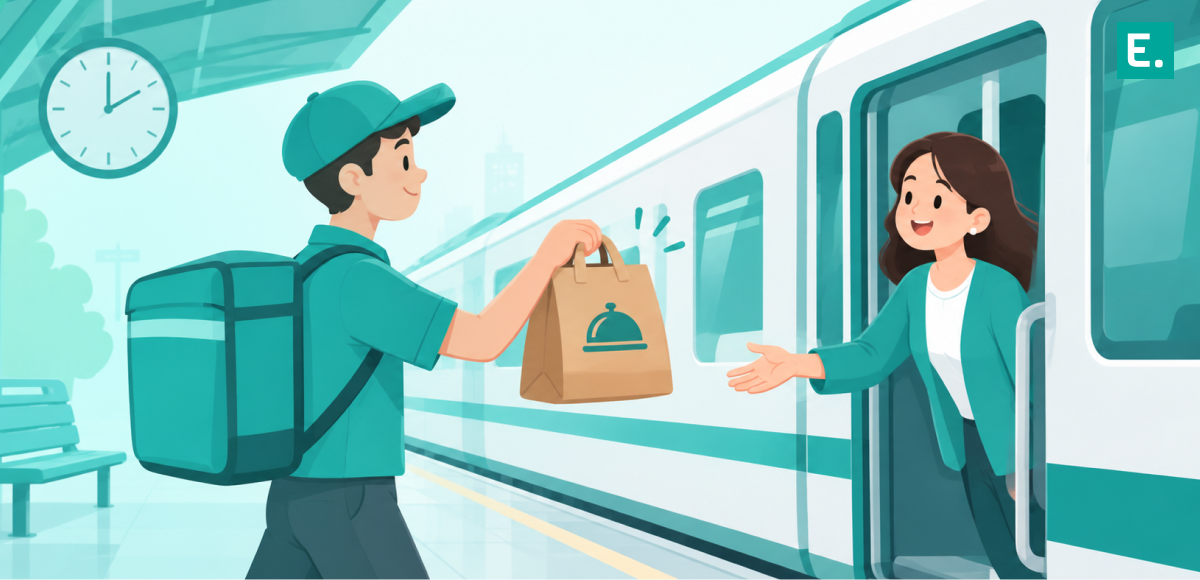
The ability to deliver hot meals in urban areas within 20 to 30 minutes relies on using static locations, GPS coordinates, and reliable doorbells. But what happens when customers travel at a speed of 110 kilometers per hour and stop only for five minutes at a train platform?
Once popular food delivery companies collaborated with national railway companies to provide meal delivery to railway seats, they entered one of the most complicated logistics spheres in the world. Adjusting the last-mile delivery systems in tier-2 and tier-3 locations according to train arrivals transformed the usual hyper-local delivery process into a time race.
The High-Stakes Friction of Railway Last-Mile Operations
In standard urban deliveries, being delayed by five minutes will only leave you with a slightly cold meal, while in a railway station setting, being delayed by two minutes may lead you to miss a train and lose your order, hence leaving a passenger disappointed. To counteract this, delivery networks have experienced heavy pressure at key points of their operations:
- Dynamic Time Constraints : due to the signals, track changes, and speed changes train schedules dynamically change;
- Complex Physical Layouts : train stations are crowded, tiered places where GPS doesn’t have enough accuracy for specific seat and coach numbers;
- Stringent Security & Compliance : getting into the station involves prior background checks for personnel, proper KYC documents and strict adherence to railway safety.
3 Core Operational Pillars of Moving-Target Delivery
1. The Fleet Design with Two Levels: Handlers and Runners
The traditional last-mile delivery system counts on a single bike driver moving from point A to point B. However, railway delivery is different because it provides for coordinated multiple changes of transport.
- Outdoor Station Handlers : These guys are responsible for picking up the deliveries from the restaurants of the city and avoiding all the traffic jams.
- Indoor Station Runners : They wait inside the stations and take deliveries at the platforms and bring them directly to their seats.
This way, such a dual fleet system prevents delivery speed from being influenced by the occupation of railway stations.
2. The Role of Live Telematics and Predictive PNR Integration
Traditional delivery platforms depend on the location of delivery personnel. However, the platforms used by train companies are integrated with the real-time rail tracking software. This means that the preparation of food changes depending on the status of the train. Orders are made in such a way that they arrive piping hot at the same moment that the train reaches the station.
3. Hyper Local Compliance and Manpower Training
Working in sensitive public infrastructure entails strict compliance. Ground personnel must undergo various background checks, food handling training, and security clearance. All this is standardized across various transit points of the region to ensure similar levels of service.